What Are Micro-Tasks? Definition, Real Examples and How You Get Paid
So, what are micro-tasks? They are small online jobs, short and guided by instructions, paid per unit once your work has been checked. This guide covers the definition, where micro-work comes from, real industry examples, how micro-tasks differ from surveys and freelancing, and how you actually get paid, limits included.
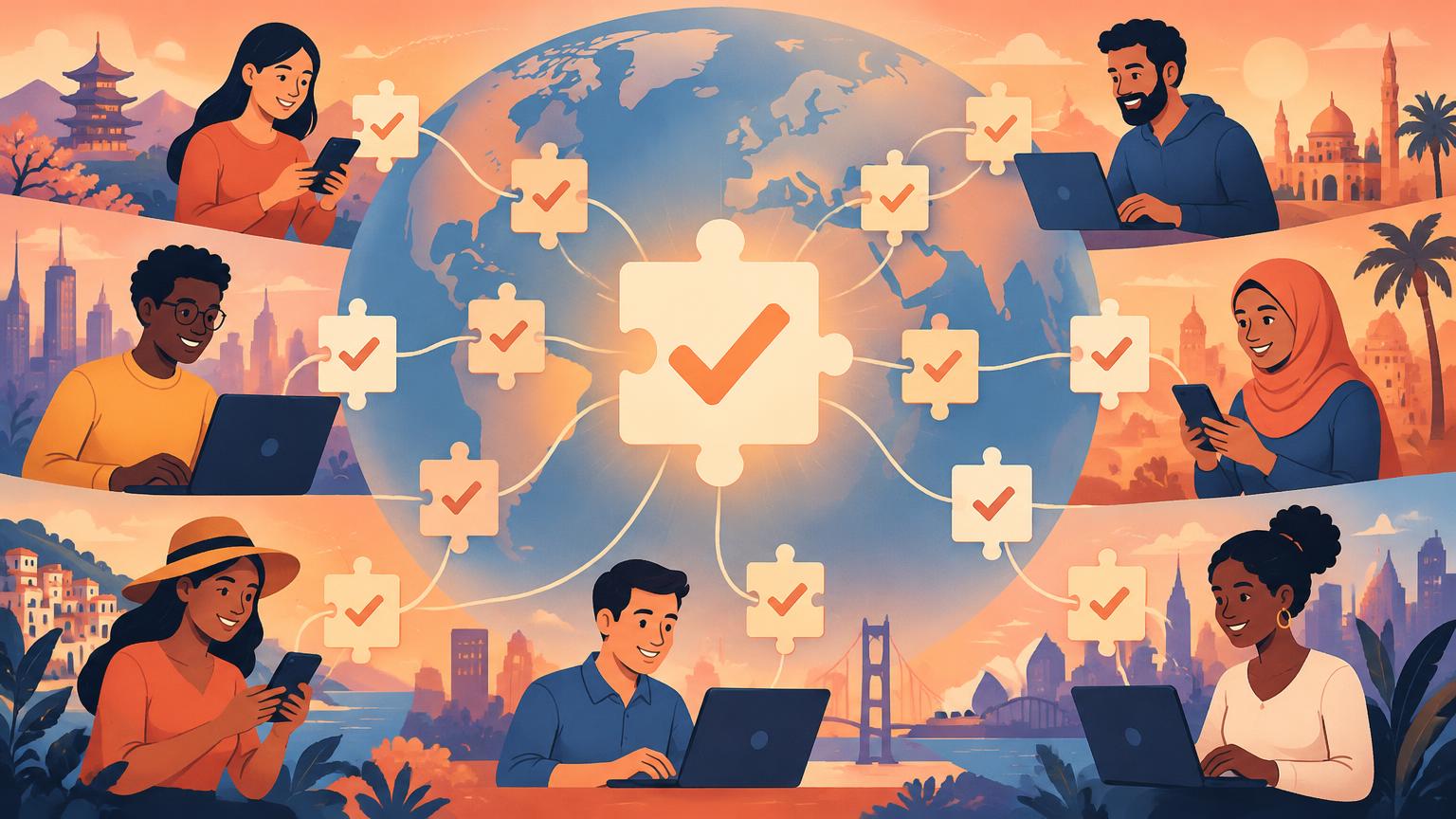
"Micro-tasks," "microtasks," "micro jobs": the term is everywhere, and it often comes wrapped in promises of easy money. This guide sets the record straight on what micro-tasks are. You will find a simple definition, the origin of the model and concrete examples from across the industry. You will also see how a task works from start to finish and how payment really works. And we talk frankly about what micro-work cannot do for you.
- approved workers
- 44,000+
- open to all nationalities
- live in Africa
- ≈ 68%
- more than two-thirds of the community
- maximum per task
- 60 min
- after that, the task expires
- tasks in progress at most
- 3
- at the same time
What are micro-tasks, exactly?
A micro-task is a small unit of work carved out of a larger project. It is done online, in a short amount of time, and it can be understood without seeing the rest of the project. The requester may need many small human judgments that a computer cannot yet produce on its own. So the work is split up and shared among many people.
This way of organizing work has a name: crowdsourcing, or sourcing work from a crowd. Micro-work refers to the activity of the people who complete these tasks, often called crowdworkers. In French, you will see the terms micro-tâches and micro-travail. On Microtaches, we simply say "workers."
Whatever the website, all micro-tasks share a few common traits:
- Short: often brief. On Microtaches, the cap is 60 minutes per task.
- Guided: written instructions tell you exactly what to do and what result is expected.
- Independent: you work by following the platform's instructions, when tasks are available.
- Reviewed: your answer is checked before you are paid. A sloppy task can be rejected.
- Paid according to the platform's rules: on Microtaches, approved tasks are credited in Ops; elsewhere, pay models vary.
Where does micro-work come from?
One well-known early service was Amazon Mechanical Turk (MTurk), launched on November 2, 2005. The name refers to a famous 18th-century chess-playing automaton that actually hid a human player inside. The idea was the same: behind a service that looks automatic, humans do the work machines cannot do.
On MTurk, each small task was called a HIT (Human Intelligence Task). After about twenty years in operation, Amazon Mechanical Turk permanently closed on September 30. Its official FAQ explains how already-approved HITs are paid. For the full story of the service, read our guide to Amazon Mechanical Turk. To find out where to work now, see our overview of sites like MTurk since it shut down.
Micro-work did not disappear with MTurk. Quite the opposite. The rise of artificial intelligence has created a huge need for data "labeled" by humans. The research firm Grand View Research estimates the data annotation tools market at $1.7 billion in 2025. It projects $10.3 billion by 2033, or 25.4% growth per year. This is a commercial estimate, best read as a ballpark figure rather than a certainty.
What are some examples of micro-tasks?
Categorizing or labeling an image
This is the most classic microtask example. You are shown a photo and asked what it contains, or you draw a box around an object. These labels are used to train or evaluate image recognition systems. This work is part of data annotation, a field that is hiring more and more.
Checking a piece of information
Is an address correct? Is a store still open? Does a listing describe the right product? These checks call for common sense and a bit of research, rarely technical skills.
Transcribing a short audio clip
You listen to a few seconds of a recording and type exactly what is said. Quality depends on your attention to detail: punctuation, proper names, and inaudible passages flagged according to the instructions.
Rating an AI response
More and more tasks involve comparing two answers from an AI assistant, ranking them or correcting them. This kind of judgment can feed RLHF (reinforcement learning from human feedback), but not all annotation is RLHF. A closely related job is evaluating search results. Google reported about 16,000 external raters in an official document from November 2023. It also publishes its guidelines for search quality raters for anyone to read.
Taking part in a research study
Researchers recruit participants for online questionnaires or experiments. That is how platforms like Prolific or CloudResearch Connect work. This sits on the line between micro-tasks and surveys, as the table below shows. To dig deeper, see our roundup of paid tasks and the gigs that actually pay.
Micro-tasks vs. surveys, user testing and freelancing: what's the difference?
These activities are often lumped together in "make money online" articles. Yet they differ in length, requirements and how you get paid.
| Micro-tasks | Surveys and studies | User testing | Freelancing | |
|---|---|---|---|---|
| Length of one unit | Short (60 min max on Microtaches) | Varies by study | One session per test | Hours to weeks per project |
| Skills | Attention, following instructions; sometimes a language or specialty | Matching the profile researchers want | Being able to talk through how you use a site or app | A trade you have mastered (writing, coding, design…) |
| Access | Approved sign-up, quality control of answers | Profile criteria; waitlist at Prolific | Screening test is common | Portfolio, prospecting, quotes |
| Payment | Per approved task (in Ops on Microtaches) | Per study; Prolific requires researchers to pay at least £6 or $8 per hour | Per test; UserTesting shows the amount upfront and pays via PayPal about 14 days later | Per project or per hour, based on your quote |
| Consistency | Varies by day, country and profile | Varies with the studies available | Irregular | Depends on your clients |
| Best suited to | Short free slots, beginners | Profiles researchers are looking for | People comfortable speaking aloud | Professionals selling expertise |
Comparison of the main forms of online work. Sources: Microtaches rules, official Prolific and UserTesting pages. Other items reflect general industry trends.
What this table shows: micro-tasks have few prerequisites and fit into short windows of time. In exchange, they offer no consistency. Freelancing is the opposite: it requires real professional skills and prospecting, but it can become a full-time activity. As for a regular job, it brings a contract, a fixed salary and social protection, which none of these options guarantee.
How does a micro-task work on Microtaches, step by step?
Before your first task, you need to create a free account. Sign-ups are reviewed by our team, so approval is not instant. Once you complete your profile, you receive a 10 Ops bonus. After that, every task follows the same path.
- 1Accept a task3 in progress max
You choose an available task and accept it. You can have up to 3 tasks in progress at once.
- 2Read the instructions shownFree drop within 10 min
Take the time to read everything before you start. If the task isn't right for you, you can drop it with no penalty during the first 10 minutes.
- 3Complete the task60 min max
You follow the instructions shown, at your own pace, within the 60-minute limit per task.
- 4Submit your answerOtherwise −20 Ops
You send in your work before the deadline. A task that expires with no answer results in a 20 Ops penalty.
- 5Review
Your answer is checked before anything is credited. An answer that doesn't follow the instructions can be rejected.
- 6Ops credited
Once the task is approved, the Ops are added to your balance. You can then spend them in the store or withdraw them, subject to conditions.
Two rules will save you a lot of frustration. Only accept tasks you can finish within the hour. And if you have doubts while reading the instructions, drop the task within 10 minutes rather than letting it expire. The review step is where everything is decided. Our guide to passing micro-task quality control on the first try covers the most common mistakes.
How do you get paid for micro-tasks?
Every platform has its own currency or pay scale. On Microtaches, earnings are counted in Ops. Their value depends on how you use them: 1 Ops is worth €0.0082 in the store (gift cards, products) and €0.0042 when withdrawn as money.
| € | |
|---|---|
| In the store | €82 |
| Withdrawn | €42 |
What this chart shows: the same balance of 10,000 Ops is worth €82 in the store versus €42 when withdrawn. The store therefore values your Ops about 1.95 times higher. If you were planning to buy a gift card anyway, that is the better deal. If you need cash, withdrawing is still an option. All the math is in our guide to converting your Ops into euros and gift cards.
The thresholds to know before you withdraw
Withdrawals follow several successive thresholds. It's best to know them from day one so you aren't caught off guard.
| Ops | |
|---|---|
| KYC access | 1,000 Ops |
| Minimum per withdrawal | 5,000 Ops |
| 1st bank transfer | at least 15,000 Ops |
| Mobile money, PayPal… | 25,000 Ops |
What this chart shows: identity verification (KYC) becomes available once your balance reaches 1,000 Ops. It is required before your first withdrawal and before your first store order. You need to provide an ID document and proof of address, and the name must match the receiving account. Processing can take up to 7 business days.
Each withdrawal request must be for at least 5,000 Ops. On top of that, a reserve of 10,000 Ops cannot be withdrawn. Your balance therefore needs to reach at least 15,000 Ops for a first withdrawal by bank transfer. For 15,000 Ops, the withdrawal value is €63, which equals 41,325 FCFA or roughly 315,000 Ar depending on the day's exchange rate.
- Fees: a flat 800 Ops for a bank transfer outside Europe. This is the only fee published by Microtaches.
- Timing: payment within up to 3 weeks after your request is approved; store orders within up to 2 weeks.
- Cap: €2,500 per year. This is an internal Microtaches rule, not a law.
Which withdrawal methods are available?
Bank transfer (IBAN) is available from the minimum withdrawal amount. MVola, Orange Money, Wave, MTN MoMo, PayPal, Skrill and Neteller are available from 25,000 Ops. You make your request from the Withdrawals page in your account. Revolut and crypto are listed as "coming soon," with no date. Airtel Money, Moov Money, M-Pesa, Free Money/Mixx and Payoneer are not offered by Microtaches. If you use one of these, you will need to choose one of the methods listed below.
Withdrawal methods on Microtaches
Your Ops can be withdrawn to a bank account, a mobile money account or an online wallet. Bank transfer is available from the usual minimum; MVola, Orange Money, Wave, MTN MoMo, PayPal, Skrill and Neteller are available from 25,000 Ops; Revolut and Crypto are coming soon.
| Type | Availability | Where it is used | |
|---|---|---|---|
| Bank transfer (IBAN) | Bank | Available from the usual minimum | Bank account with an IBAN, in Europe or elsewhere (fixed fee outside Europe) |
| MVola | Mobile money | Available from 25,000 Ops | Madagascar |
| Orange Money | Mobile money | Available from 25,000 Ops | Madagascar, Ivory Coast, Senegal, Cameroon, Mali, Burkina Faso, Guinea, DR Congo… |
| Wave | Mobile money | Available from 25,000 Ops | Senegal, Ivory Coast, Mali, Burkina Faso… |
| MTN MoMo | Mobile money | Available from 25,000 Ops | Ivory Coast, Cameroon, Benin, Guinea, Congo, Ghana… |
| PayPal | Online wallet | Available from 25,000 Ops | Countries where PayPal lets you receive money |
| Skrill | Online wallet | Available from 25,000 Ops | International online wallet |
| Neteller | Online wallet | Available from 25,000 Ops | International online wallet |
| Revolut | Neobank | Coming soon (no date yet) | Coming soon |
| Crypto | Cryptocurrency | Coming soon (no date yet) | Coming soon |
Methods shown on the Withdrawals page of your Microtaches account. Countries listed are examples where the service is common.
For a cash withdrawal at an agent, the operator's fees apply. In Madagascar, the official fee schedule is the same at MVola, Orange Money and Airtel Money: 1,900 Ar to withdraw 100,000 Ar, and 4,700 Ar for 500,000 Ar. For country-by-country details, see our guide to online work in French-speaking Africa.
Who does micro-tasks, and why?
Micro-work is a global activity. The Microtaches community has more than 44,000 approved workers. It mostly reflects French-speaking Africa and Europe.
| workers | |
|---|---|
| Africa | ≈ 30,400 (68%) |
| Europe | ≈ 11,500 (26%) |
| Asia and Oceania | ≈ 1,700 (4%) |
| Americas | ≈ 900 (2%) |
What this chart shows: more than two-thirds of workers live in Africa. Madagascar alone accounts for about a third of the community, with more than 14,000 people. It is followed by France (over 10,000), Ivory Coast (nearly 3,500) and Cameroon (over 3,200). Country eligibility varies by platform, so workers should always check the official list before signing up. For example, Prolific's list of eligible countries includes neither Madagascar, Ivory Coast, Cameroon nor Senegal.
Profiles vary widely. The following situations are illustrative examples, not testimonials:
- Aina, a student in Fianarantsoa, does a few tasks between classes. She is aiming for a gift card in the store rather than a withdrawal, because Ops are worth more there.
- Moussa, a technician in Abidjan, works in the evenings. He checked from the start that the 25,000 Ops threshold applied to Orange Money and Wave, so he wouldn't count on withdrawing too early.
- Claire, a retiree near Lyon, likes the flexibility: no obligation to log in, and an IBAN transfer is possible from the minimum withdrawal amount.
The motivations are similar: topping up a budget, making good use of downtime, working without a degree or an office, or getting a look behind the scenes of artificial intelligence.
Can paid micro-tasks be a real income?
No, not in the sense of a salary. On Microtaches as elsewhere, the number of available tasks varies by day, country and profile. Some days there are plenty; other days, almost none. No income is guaranteed, and it would be dishonest to promise you an amount per hour or per month.
You also need to accept several constraints specific to Microtaches. Sign-up is not instant, and the 10,000 Ops reserve cannot be withdrawn. Mobile methods are only available from 25,000 Ops, and a payment can take up to 3 weeks. The €2,500 annual cap also limits, by design, how much you can withdraw.
A flexible, accessible side income, as long as you don't expect the stability of a job.
- Free sign-up, reviewed by the team
- Short tasks you can do when they are available
- Open worldwide, to all nationalities
- Payment by mobile money, PayPal or bank transfer, depending on thresholds
- Variable task volume, unpredictable income
- Withdrawal thresholds and a reserve to reach
- Payment can take up to 3 weeks
- No contract or social protection
If you're just starting out, take it slow: a few well-done tasks are worth more than a rushed batch that gets rejected. Our beginner's guide to micro-work from home helps you organize your first weeks.
How can you tell a legit micro-task site from a scam?
The popularity of micro-work attracts scammers. The U.S. Federal Trade Commission (FTC) recorded about 20,000 reports of task scams in the first half of 2024, compared with 5,000 for all of 2023. A common scheme is this: fake earnings appear on screen, then you are asked to make a deposit, often in crypto, to "unlock" your money.
- Good sign:Free sign-up, with no deposit or "activation fee"
- Good sign:Published withdrawal rules: thresholds, timing, fees
- Good sign:Identity verification before the first payment
- Good sign:Tasks reviewed before being paid
- Good sign:No guaranteed, specific earnings promises
- Warning sign:You're asked to send money in order to withdraw your earnings
- Warning sign:Recruitment via private message only
- Warning sign:Very high earnings for clicks or "likes"
- Warning sign:Crypto payment required to "level up"
A single red flag is enough reason to stop. Our checklist for legit work from home without ever paying upfront walks through the most common scam scenarios.
Do you have to report micro-task income on your taxes?
Generally, yes: money earned from an online activity is still income. The rules, however, depend on your country of residence, your status and the amount you receive. We cannot give you a universal threshold. Check with your country's tax authority. For French residents, our guide to declaring micro-task income to the French tax office covers the details.
Sources
- AWS, Amazon Mechanical Turk announcement: launch of the service on November 2, 2005.
- MTurk, closure announcement: permanent closure on September 30.
- MTurk, FAQ: how approved HITs are paid.
- Google, Search Quality Rater Guidelines: public guidelines for search raters.
- FTC, task scams: rise in reports and the "never pay to get paid" rule.
- Grand View Research: commercial estimate of the data annotation tools market.
- Prolific, eligible countries: official list of eligible countries.
- UserTesting, payments: PayPal payment about 14 days after each test.
Micro-tasks: frequently asked questions
- What are micro-tasks?
- Small online jobs, short and guided by instructions, paid per unit once they are checked. Industry examples include categorizing an image, checking a piece of information and transcribing a short audio clip. Together, these tasks make up micro-work.
- Do micro-tasks really pay?
- Yes, on legit platforms, as long as the task is approved. On Microtaches, earnings are credited in Ops after review. Task volume varies and no income is guaranteed.
- How long does a micro-task take?
- Up to 60 minutes on Microtaches. You can drop a task with no penalty during the first 10 minutes. If a task expires with no answer, a 20 Ops penalty applies.
- Do you need a degree to do micro-tasks?
- What matters is reading the instructions carefully and applying them with care; always check the platform's own access rules. Some tasks in the industry require a language or a specialty; requirements depend on the platform and project.
- Can you make a living from micro-tasks?
- No, that is not realistic for most people. The number of tasks varies by day, country and profile. It is a side income, not a salary. On Microtaches, an internal cap of €2,500 per year also applies to withdrawals.
- Is Amazon Mechanical Turk still running?
- No. Launched in 2005, Amazon Mechanical Turk permanently closed on September 30. Other micro-task and online research platforms remain active.
- Do you have to pay to join a micro-task site?
- No. A legit platform never asks for money to sign up or to unlock your earnings. Signing up for Microtaches is free. Any request for a deposit is a scam warning sign.
- How much is 1 Ops worth on Microtaches?
- €0.0042 when withdrawn and €0.0082 in the store. So 10,000 Ops are worth €42 as a withdrawal or €82 in gift cards and products, about 1.95 times more in the store.
- When can I make my first withdrawal?
- Once your identity is verified and your balance reaches at least 15,000 Ops for a bank transfer. That figure is the 5,000 Ops minimum plus the 10,000 Ops reserve. Payment arrives within up to 3 weeks after your request is approved.
- Can I get paid by mobile money?
- Yes. MVola, Orange Money, Wave and MTN MoMo are available from 25,000 Ops, from the Withdrawals page in your account. Airtel Money, Moov Money and M-Pesa are not offered by Microtaches.